
AIRBNB EXPERIENCES
Cultural Intelligence · Editorial Design · AI Product Development
Turning emerging cultural signals into actionable marketplace intelligence—helping Airbnb identify where new Experiences supply could create future demand.
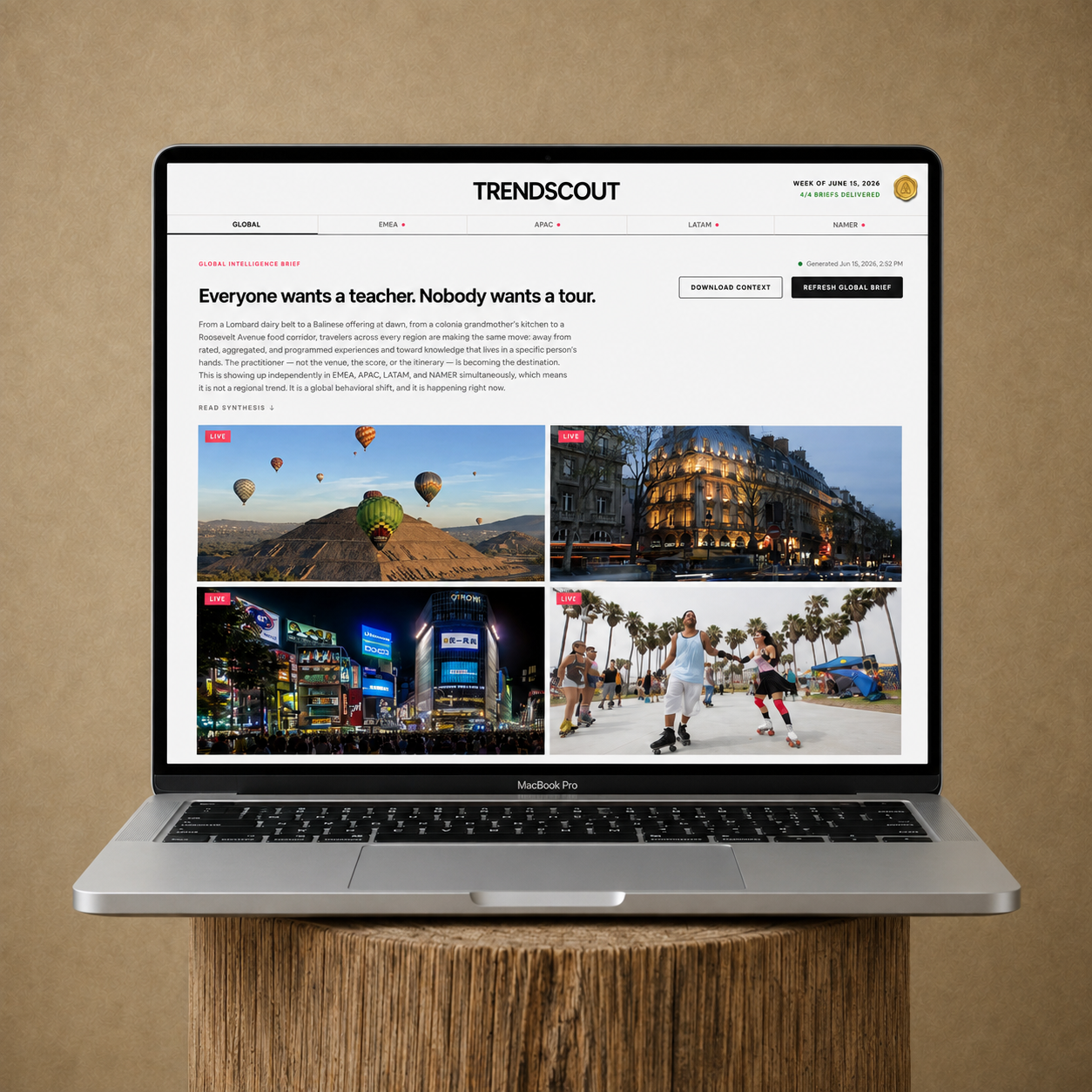
IMPACT
Designed and prototyped an AI-assisted cultural intelligence product spanning ten cities and four regions—combining a curated editorial knowledge model, community signals and live marketplace performance to generate sourceable leads and portable intelligence for Airbnb’s supply-planning process.
CULTURE MOVES BEFORE THE MARKETPLACE
Experience supply changes more slowly than culture. By the time a behavioral shift is clearly visible in marketplace data or formal consumer research, the people, places and practices behind it may already have been developing for months.
Airbnb’s Offline Design curators were already skilled at noticing those shifts—following local media, practitioners, traveler communities and what guests were beginning to seek out—but much of that intelligence lived across individual research habits, browser tabs, conversations and market knowledge. At the same time, Airbnb had increasingly sophisticated visibility into what guests were already booking. What was missing was a systematic way to bring those two views together.
I conceived Trendscout around that gap: how could Airbnb continuously read the changing cultural landscape of its cities, identify what might matter for Experiences and bring that intelligence into the same planning process as marketplace performance? The goal was not trend prediction — it was to create an earlier, more structured signal that revealed which new hosts, formats and experience concepts might be worth investigating.



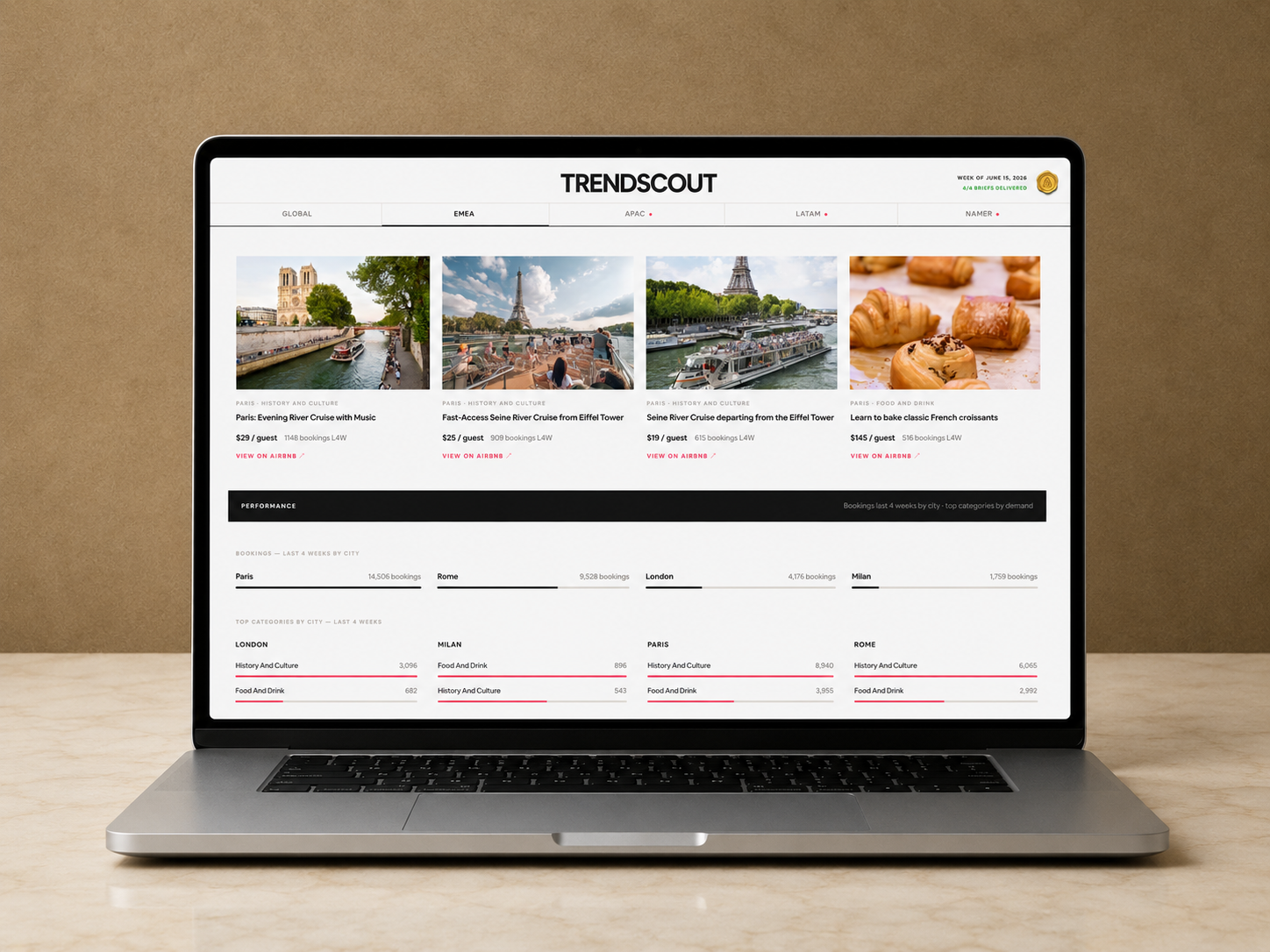
FROM SIGNAL TO INTELLIGENCE
On the front end, I designed Trendscout to function like a digital magazine built specifically for Airbnb—closer in spirit to Monocle than a conventional analytics dashboard. Each weekly edition translated a large research field into a global cover story, regional pulses, city dispatches and concise cultural signals, complete with supporting sources and specific people, venues and practices worth exploring. The product itself was explicitly designed as an editorial-quality brief rather than a raw research feed.
Behind that editorial experience sat a much more rigorous knowledge model. I defined a curated set of global, regional and native-language editorial sources and encoded a prompt to review them through the lens of city-specific priorities and editorial lenses along with source-authority and recency rules and community-signal scoring designed to separate useful behavioral evidence from generic travel noise. Editorial reporting had to anchor every signal, community conversation could corroborate but never lead the conversation, and each finding required multiple independent sources.
AI worked inside that structure rather than deciding independently what was culturally important. The prompt architecture taught the system what to look for in each city, what to ignore and how to translate a large research pool into concrete outputs: a brief with clear cultural rationale and relevance to Airbnb Experiences. The differentiating value was not simply the model, but the source curation, scoring logic and editorial judgment surrounding it.
DESIGNED LIKE AN EDITORIAL DESK
The product was designed to move beyond observation into marketplace action. Each regional brief placed emerging cultural signals alongside live Airbnb performance: top Experiences, recent bookings, category demand and existing supply. That allowed curators to see where cultural momentum and marketplace behavior were converging, where Airbnb was already well positioned and where there might be genuine whitespace.
The system then translated promising patterns into more actionable supply intelligence. Regional synthesis produced specific opportunity hypotheses tied to an activity, host type, audience and place, with source links that could also become leads for sourcing. A signal about changing urban social life, for example, was not valuable because it declared something “trending”; it was valuable when it could help a curator ask what kind of person, practice or place should Airbnb be looking for next?
I also designed the briefs so their underlying context could be exported directly from the interface. Global and regional views included a “Download Context” function that packaged the relevant evidence into reusable text, allowing curators to carry the research into downstream work rather than leaving it trapped inside the product.
That made Trendscout useful inside the broader supply planning process. Cultural signals could become another evidence layer alongside consumer insight reports, snapshots of marketplace performance and existing supply—helping curators move quickly from observation and interpretation to supply hypothesis and market priority.
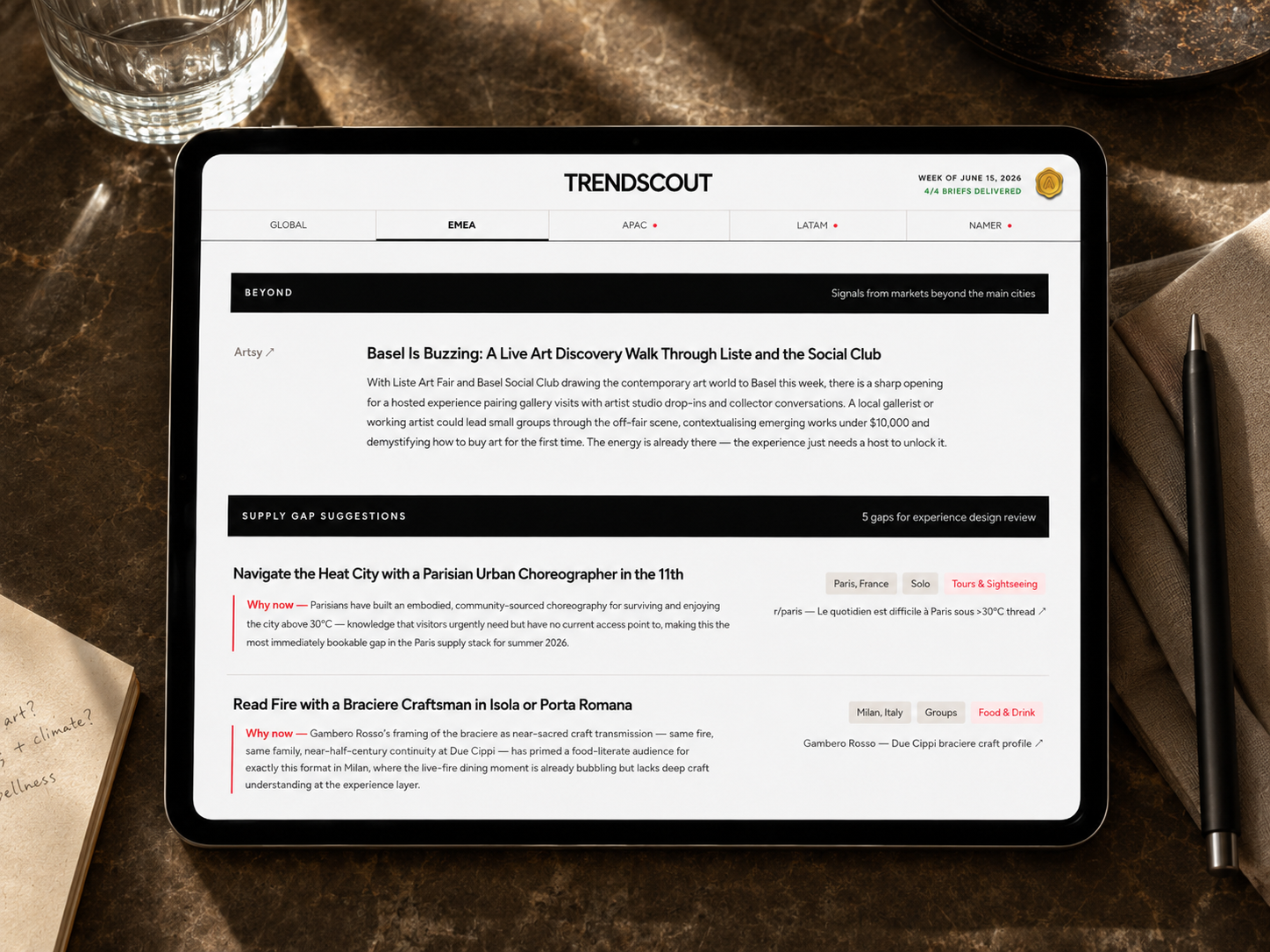
ONE READ ON CULTURE AND DEMAND
Trendscout turned cultural scanning from an individual curator habit into a repeatable intelligence layer for supply discovery and planning.
I conceived and prototyped the product, designed its editorial and AI architecture, developed the source and knowledge model and connected it to live marketplace data across ten cities and four global regions. The system moved from city-level evidence through regional synthesis to a global editorial perspective while preserving the sources behind each recommendation.
The product also made that intelligence portable. Curators could move from what was culturally emerging, to what guests were already choosing, to specific opportunities and leads, then carry that context directly into the work of defining new supply priorities for their markets.
As the work matured, Trendscout began feeding into broader supply-planning and trend discovery conversations alongside the Consumer Insights and other cross-functional teams.
Its larger value was not in predicting the future, but giving Airbnb a disciplined way to notice change earlier, filter it through a product-specific point of view and turn the strongest cultural signals into evidence for what Experiences it might build next.