AIRBNB EXPERIENCES
Design Operations · AI Product Development · Marketplace Quality
Building a shared quality layer for Airbnb Experiences—helping a globally distributed team apply Design judgment consistently from incoming supply to live marketplace learning.
IMPACT
Designed two AI-assisted review tools that cut routine assessment from minutes to seconds and helped teams make more consistent quality decisions across incoming and live supply.

SCALING QUALITATIVE JUDGEMENT
Airbnb Experiences depended on qualitative decisions that were difficult to standardize at marketplace scale. Every submitted listing presented a unique combination of host, activity, place and market context, and determining whether those elements came together into a compelling and marketable product offer required more than checking a set of rules.
The challenge was particularly acute in the Organic supply funnel, where hosts around the world could submit Experiences directly. Scaled vetting teams handled large volumes of incoming supply, while Design curators provided the deeper experiential expertise: calibrating quality, resolving ambiguous cases and helping teams understand how the standard should be interpreted across different markets and formats.
At the same time, quality did not stop mattering once an Experience was published. The business also needed to understand how supply was showing up after launch: where Supply and Operations were consistently delivering against the Design standard, where additional support might be needed, and which strong Experiences had the potential to grow.
As lead curator for Organic supply, I focused on those two moments: helping qualitative Design expertise travel further through the inbound funnel, and creating a faster feedback loop around the quality of supply once it was live.



TURNING HUMAN INSIGHT INTO SHARED REASONING
While a set of criteria could define the quality bar, much of the real expertise for vetting experiential supply lived in how curators interpreted those standards across different hosts, formats and market contexts. Through repeated calibration with curators and scaled review teams, I identified where interpretations diverged, which edge cases created friction and which cues experienced reviewers relied on when the written criteria alone were not enough.
I translated those patterns into an AI reasoning model that combined the formal quality framework with examples, recurring failure modes and contextual signals drawn from real review decisions. The model gave AI enough context to scan a listing, organize the qualitative evidence, recognize familiar patterns and provide a credible first read rather than forcing reviewers to begin from scratch.
With curators and vetting agents reviewing dozens of Experiences each day, that first read helped direct attention toward the parts of each case that were most consequential—while preserving human ownership of the final creative decision and giving curators more time for the cases where taste, nuance and local knowledge mattered most.
SCALING TASTE THROUGH THE FUNNEL
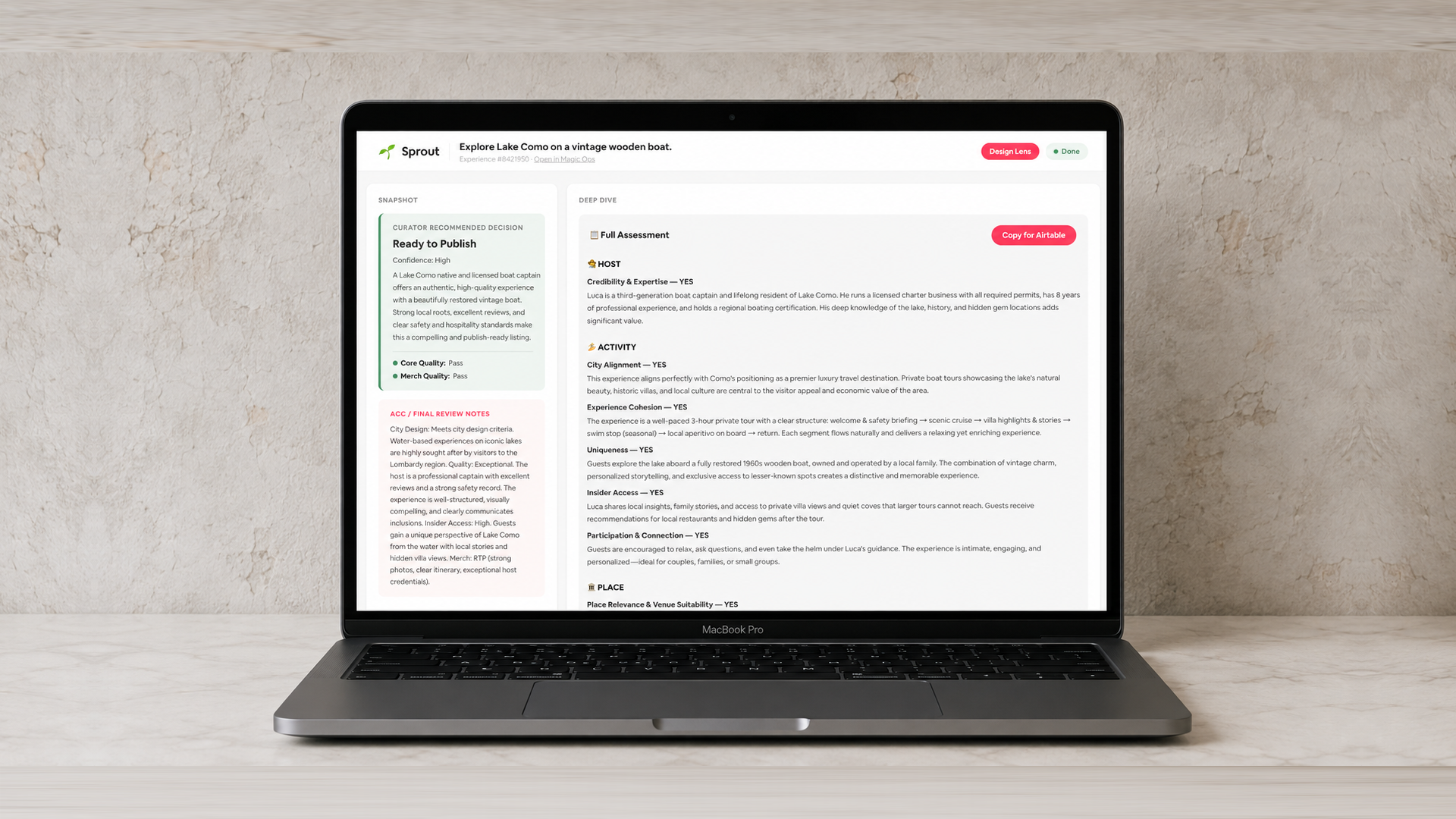
Sprout was the first product expression of that reasoning model, built specifically for Airbnb’s Organic supply funnel. Incoming submissions arrived in inconsistent formats and with uneven information across the host, activity, place and practical details, making even straightforward listings time-consuming to parse. That challenge was amplified by a globally distributed Design team: curators were working across regions and time zones, often without the ability to grab a second opinion or calibrate a difficult read with a colleague in the moment.
I built Sprout as a one-click browser tool that gathered the relevant context automatically, applied the shared reasoning model and returned a structured assessment with a recommended direction, confidence level and rationale. It also generated reusable routing information, tags and working notes that could move with the listing through downstream workflows. Beyond speed, this created a more consistent baseline for how curators framed their feedback—giving the team a shared starting vocabulary even when colleagues were working independently across different markets.
For straightforward supply, a first read that had previously taken several minutes could happen in seconds. For more ambiguous cases, Sprout functioned less like an answer and more like an always-available second read: surfacing the likely quality questions so a curator could interrogate them rather than reconstruct the entire case alone. The result was more effective individual decision-making within a distributed team, greater consistency in the feedback moving through the funnel, and more curator attention reserved for the judgments where taste, nuance and local knowledge could genuinely change the outcome.
TURNING SUPPLY INTO A FEEDBACK LOOP
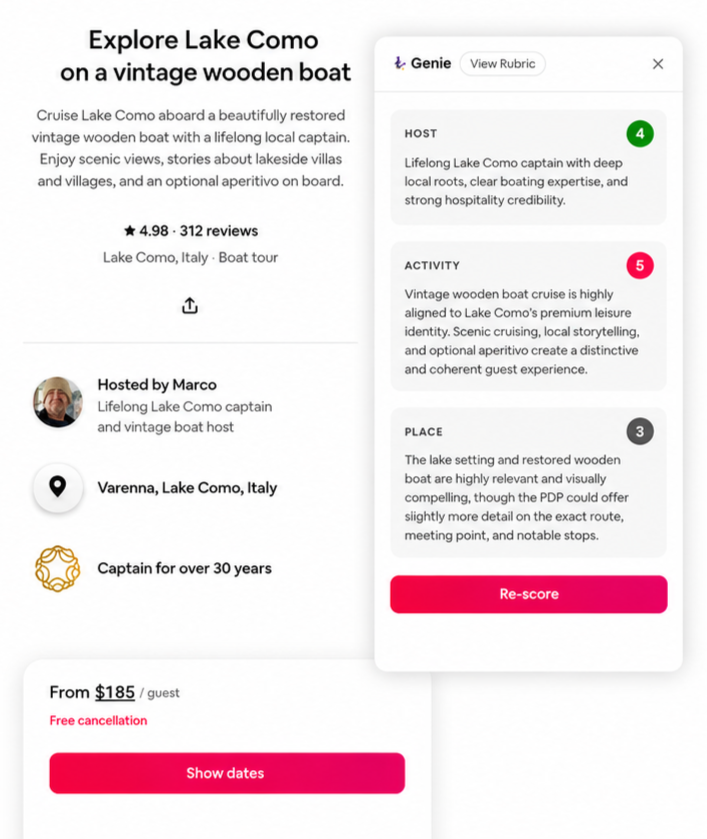
Once supply was live, the same reasoning model could work in reverse—helping Design learn from what had made it through the funnel. I extended it into Genie, a lightweight tool for assessing live Experiences across the marketplace.
With a click, curators could generate a structured read across the host, activity and place, see the rationale behind the assessment and quickly identify where the proposition was strong or where one component was out of balance. That created a more consistent basis for feedback to Supply and Operations, while also making it easier to surface strong Experiences with room to grow.
Used across a broader body of live supply, Genie turned individual reviews into organizational learning. Patterns could reveal where teams needed more support, where aspects of the quality standard required clarification, and which strengths or weaknesses should inform future supply decisions.
Together, Sprout and Genie created a feedback loop: Sprout helped Design expertise travel forward through the Organic funnel, while Genie brought learning from live supply back into the system.